Type: Team Project, 13 members
Development: August '24 - May '25
Description: "Realm Runner" is a 3D fast paced action platformer starring Astro Eskii Dawdle, a competitor in the multiversal game show titled the Microcosm Marathon. Run through beautiful and branching levels as you take full advantage of Astro's speed and squid-like powers!
Responsibilities: Collaborated with 2 other designers to create level layouts for four levels. I was personally responsible for whiteboxing, blueprints, set dressing, pace of play, and further iterations and changes for Floating Islands Act 1 and Gradient Gulch Act2. I also created the level intros.
Tools Used: UE5, Blueprints, Procreate, Figma
Steam Link: Go To Page
Realm Runner

Pre-Production
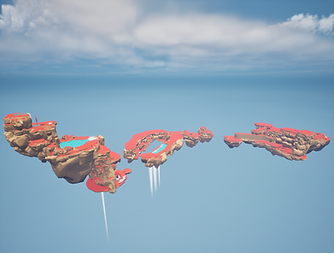
One of the largest draws of Realm Runner was the ability to have vastly different environments with each of our levels so during the pre-production phase one of our first orders of business was figuring out what our realm themes would be. We decided our first realm would be the Floating Islands, and Gradient Gulch became our second and final realm. The intention was to have four realms each with two levels but after the first semester we realized that wouldn't be feasible.
Our process with the Floating Islands level concept and layout was very collaborative with each of the designers creating their own layouts which we'd then go over, pick the best bits, and piece together a level that we felt flowed well and created the best moment to moment gameplay. The majority of my islands ideas were chosen for Act 1 so that became my responsibility.
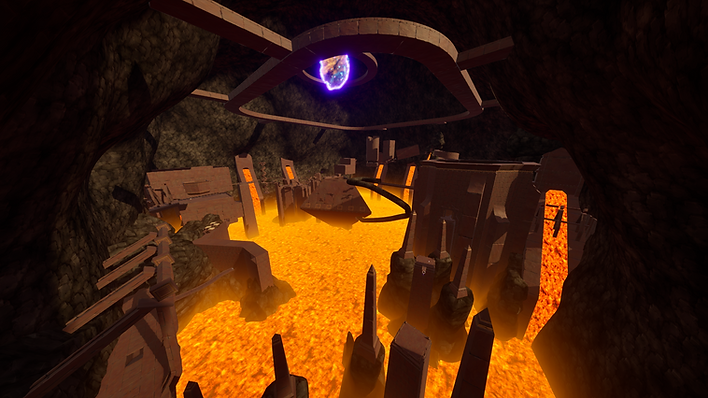
For Gradient Gulch our design process was slightly more streamlined with a pipeline in place, and less time spent concepting, however for the second act we wanted to go for something very ambitious and wanted to create a set of trials that had to be completed, this was a fun idea but would ultimately leave us over-scoped. I was assigned to concept and block-out the level with another designer who doubled as our sound designer who ultimately needed to put more resources towards that so Gradient Gulch Act 2 became my responsibility.
Floating Islands Concepts


Gradient Gulch Concepts


Production
During our pre-production discussions and concepts our initial layouts were solidified. Our core gameplay mechanics relied heavily on our complex and constantly changing character controller so we began whiteboxing and play testing as soon as possible. The disjointed nature of the floating islands made it easy to iterate and switch out sections if needed. Gradient Gulch act 2 proved to be much more difficult. Although we had solidified the mechanics we wanted in the level, we had to overhaul the layout massively due to concerns with level length and pace of play.
Once whiteboxes were completed the art team would take our proxies and convert them into assets for set dressing as well as giving us a pack of rocks and foliage to set dress the level as desired. Once level population was complete static mesh actors were merged to improve optimization, and our lighting artist would go through and light the level as desired.
.png)
.png)
.png)
.png)
.png)
.png)
_edited.jpg)
.png)

Gameplay & Gallery



Post Mortem
Overall this was an incredibly fun project to work on and I was very lucky to be joined by an equally as fun and incredible team. I will undoubtedly look back on this time fondly. Some of the biggest lessons I took away fromworking on this project were:
Scope: Proper scope is paramount to making sure you ship the best possible product you can. We all want to pack our games with the best mechanics and moments but it can't come at the cost of the overall product. Sometimes taking a step back and reassessing is a necessity. Learning to accurately gauge our scope was so important.
Adapting with a team: As this was a small student based team at the end of the day the process was extremely collaborative. We all had our own ideas on how we wanted the game to look. Being able to to approach everything with an open mind and understanding that all my ideas won't get picked or may not be feasible was important. Combined with meeting new people and personalities as well as being adaptable to my environment socially and mentally was key.
Be ready for change: As we worked time constraints and playtesting changed the game more than we anticipated. In one instance we had to overhaul a whitebox massively to achieve a better overall level feel. These were things as a designer I knew I had to be ready for especially given our characters ability. Adopting a change ready mindset and having back up plans was an important addition to my mental toolkit.